
Added to cart succesfully!
Curator: Catalina Bagnato Irigoyen
September 10 – October 21, 2026
Opening at Cassia House: Thursday, September 10
Opening at Centro de Edición: Saturday, September 19
Cassia House and Centro de Edición present Materia Umbría, an exhibition of contemporary graphic art unfolding in parallel between Recoleta and Villa Lynch, bringing together artists from different generations around shadow, ink, paper, and the possibilities of an image capable of multiplying.
The exhibition features works by Alejandro Avakian, Sofía Llambías, Ana Lía Werthein, León Ferrari, Rosa Amarilla, Ana Steinnekker, Marta Minujín, Marta Biagioli, Natalia Giacchetta, Jazmín Puyén, Daniela Krainer, Walter Pugliese, Gustavo Amenedo, Delfina Aversa, Katerina Atamañuk, and Melisa López.
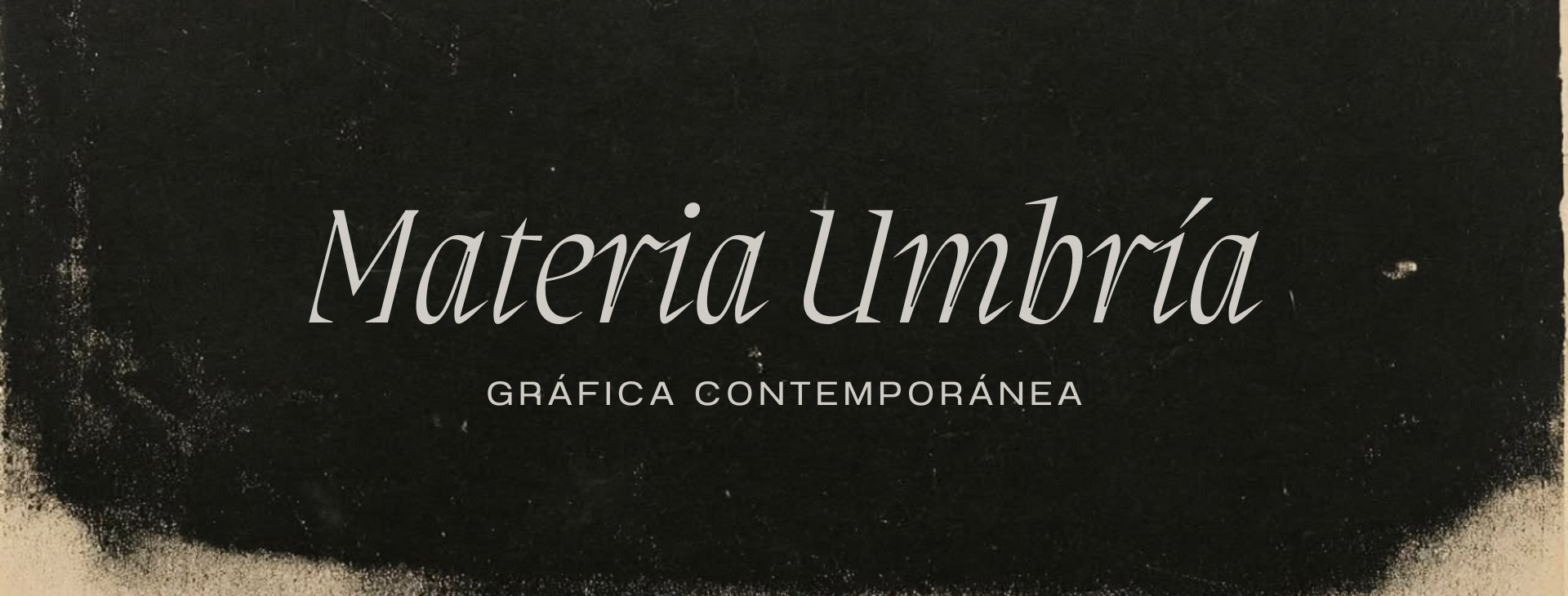
Two galleries separated by three decades of history construct a single shared trajectory. Centro de Edición contributes the tradition of the workshop, the matrix, the press, and a craft passed down across generations; Cassia House brings a new space for circulation and encounter. Between them, graphic art appears not as a secondary practice, but as a living archive capable of crossing time, territories, and languages.
This exhibition brings together images that emerge from the depths of ink, from the shadow of a stone, from the recesses of cracks and the scars of materials traced point-first by their creators.
For three decades, Centro de Edición has been dedicated to producing and exhibiting graphic art, sustaining within it a workshop-gallery where shadows become images, are printed, and multiplied. Cassia House has just celebrated its first year and supports a new generation of artists whose careers are beginning to expand along the paths of ink. The temporal distance between the two projects is considerable, yet the encounter between their artists reveals the importance of a practice that crosses generations, a craft that remains engraved at the heart of Argentine art.
Our artists share the same interest in constructing spaces, identities, and natures that only exist when light recedes, creating poetry through a medium often “eclipsed” by the “Grand History of Art,” which built a fetish around painting and sculpture while leaving the graphic arts aside. And it is precisely the generosity of a medium capable of bringing numerous replicas into existence that invites us to reveal its living, timeless archive: a place where impressions by artists from the past can still coexist with works printed yesterday.
“Materia Umbría” explores the particular nature of a beauty found not in carved stone or worked canvases, but in their negatives, in the shadows cast by those objects. We propose entering the recesses of this pristine material, capable of constructing silences and pauses, hiding places and shadows; a medium able to expand like no other and engage with an endless range of supports, spaces, scales, and materials.
- Catalina Bagnato Irigoyen
In Materia Umbría, shadow ceases to be merely the consequence of a body interrupting light and becomes a material in its own right. It appears in the depth of ink, in the trace left by a lithographic stone, in the grooves of a matrix, in a fold, or across a surface. From there, the works construct landscapes, bodies, identities, architectures, and spaces that oscillate between the visible and the hidden.
The exhibition also finds, in the very nature of graphic art, a way of connecting its two venues. An image can be printed, displaced, and reappear; a work produced decades ago can coexist with another that has only recently left the workshop. This reproducibility, historically used to relegate graphic art in relation to painting or sculpture, becomes here one of its greatest strengths: it allows images to survive, circulate, and encounter new generations once again.
Cassia House and Centro de Edición thus operate as two parts of a single exhibition. Recoleta and Villa Lynch, a young gallery and a workshop-gallery with three decades of history, historical artists and new generations, are brought together through a practice capable of extending across time. Between both venues, the same search persists: to construct new worlds from what remains in shadow.
We would like to extend our special thanks to Inizio della Vespera for accompanying the openings with their wines; to Fundación Augusto y León Ferrari Arte y Acervo, Museo de Gráfica Contemporánea (MGC), Devolver – Atelier de Restauración, and VoyVeo for their support in making Materia Umbría possible.